

Dannevirke, Slesvig
Overview
The folk costume of the Dannevirke region is a profound expression of "borderland" identity. Situated at the historic gateway between the Danish Kingdom and the German duchies, the attire here evolved from a functional rural dress into a powerful national symbol. Dannevirke is the fateful medieval (started in 808AD) defensive fortification line that the Danes built to keep out the Franks and later (unsuccessfully) the Prussians. During the Second Schleswig War of 1864, the Danish king insisted that his army stand and fight at the Dannevirke over the objections of his generals who told him that the outdated Dannevirke fortifications were untenable. In short, the generals were right, and the Danes got crushed. However, it's hard to envision any other outcome, no matter where the Danes had chosen to stand, as they were greatly outnumbered.
F.C. Lund
Interestingly, during F.C. Lund's travels in the 1850s and 1860s, he noted that Dannevirke actually had its own folk costume. Luckily for us, he sketched it, otherwise it would have vanished without a trace! The specific aesthetic captured in mid-19th-century sketches, such as those by F.C. Lund, highlights a transition from traditional peasant layers to a more stylized, "National Romantic" silhouette that defined the Danish spirit during the Schleswig Wars.
Cultural Distinctiveness and Influences
The culture of the Dannevirke was shaped by its role as a defensive bulwark. Unlike the isolated maritime cultures of the North Sea, this was a land-based, agrarian region heavily influenced by the traffic of soldiers and merchants. The costume became a visual language of loyalty. Following the loss of the territory in 1864, the Danish-minded population used these garments as a "silent resistance" against Prussian cultural assimilation.
Usage as Daily Wear
The costume’s classic form was most prevalent from 1750 to 1864. While the men transitioned toward modern suits earlier, the women’s costume remained a staple for Sunday church and festive gatherings well into the late 19th century. Today, it is meticulously preserved by the Danish minority in South Schleswig, representing a culture that remains "Danish at heart" despite living south of the modern border.
Women's Costume
-
Shirt and Blouse: The linen shirt is worn under a distinctive blouse characterized by "leg-o'-mutton" (ham-sleeves), which are voluminous at the shoulder and taper toward the wrist. A defining feature is the sharp black border or velvet ribbon that trims the high neckline and the cuffs, providing a graphic contrast to the white or patterned fabric.
-
Skirt (Skørt): Moving away from the solid dark wools of the north, the Dannevirke skirt often features wide vertical stripes. A classic combination is burgundy (madder red) and cobalt blue, which creates a vibrant, rhythmic visual that stands out against the green plains of Schleswig.
-
Apron (Forklæde): Usually a dark, contrasting fabric for daily use, or a white, starch-stiffened linen version for festivals.
-
Jewelry (Smykker): Silver lacing eyelets (snørehuller) on the bodice and a silver heart-shaped brooch are common.
-
Headgear and Sun Hat: While a silk cap was standard for indoors, the Dannevirke region is famous for the large straw sun hat. This wide-brimmed hat, often tied over the indoor cap with a silk ribbon under the chin, was both a practical necessity for the sun-drenched fields and a fashion statement that differentiated Dannevirke women from the "bonneted" women of the north.
-
Scarf (Tørklæde): A silken or fine wool shawl, often featuring a floral or paisley border, tucked neatly into the bodice.
Men's Costume
The men's dress is a blend of the "free farmer" aesthetic and military-inspired structure.
-
Shirt: White linen with a high, standing collar, often worn with a dark silk neckerchief.
-
Trousers: Traditionally yellow leather breeches, buckled at the knee, though long dark trousers became common by the mid-1800s.
-
Waistcoat (Vest): A bright red wool waistcoat, double-breasted with two rows of silver buttons.
-
Jacket (Kofte): A long, dark blue or grey wool coat with a high collar and brass buttons, mirroring the "Landeværn" (militia) uniforms of the era.
-
Headgear: A low-crowned black hat or a red knit "toplue" (peaked cap).
Comparison and Heritage
The Dannevirke costume serves as a fascinating bridge between the different provinces of the Danish Realm.
-
Versus the rest of Jylland (Jutland): Most Jutlandic folkedragter (such as those from Ringkøbing or Viborg) are far more somber, utilizing heavy dark wools and modest, dark headscarves. The Dannevirke costume, with its vibrant vertical stripes and the distinctive straw sun hat, is much more theatrical and visually "assertive" than its mainland cousins to the north.
-
National Symbolism: The Dannevirke costume is unique because it is a "Borderland Costume." It represents the final frontier of Danish culture in the south. Every element—from the silver buttons to the striped skirt—acts as a reminder of a time when the Danish border was anchored at the ancient walls of the Dannevirke, making it perhaps the most politically significant of all Danish folkedragter.
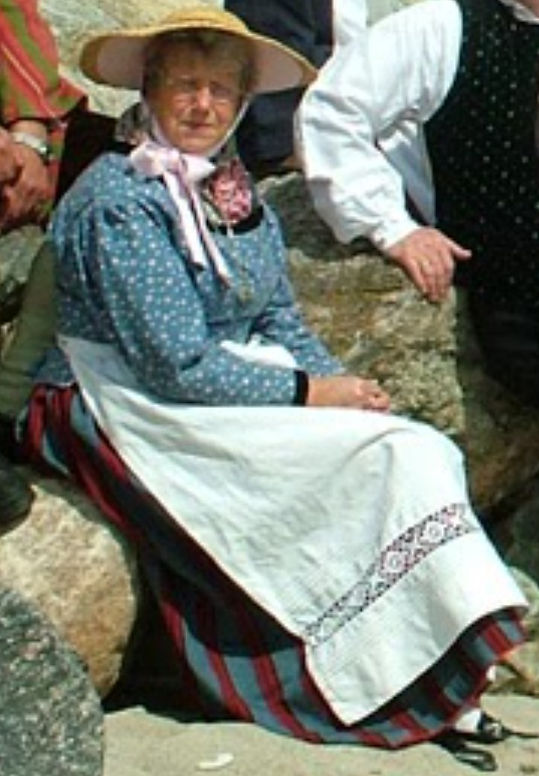
A terrific and faithful recreation of the F.C. Lund sketch costume (below)! That skirt fabric and the hat must have been custom made. She even has the ham sleeves and the black silk trim on her jacket. A+ for effort!

Seen in Kalundborg, 2026
Image Credit: DanishFolkCostumes.com
