

Østjylland Region

Women's Costumes
The Østjylland region's women's folk costumes are notable for the following reasons:
There is some scholarship to suggest that Østjylland does have at least one costume that is unique to the region, and that is its heavily embroidered "Red Østjylland." Even within the region, it seems to have been uncommon, perhaps because the embroidery was surely quite expensive. It is absolutely stunning, and is not unlike the Red Strandby, but has even more embroidery.
Sniptøj Headgear
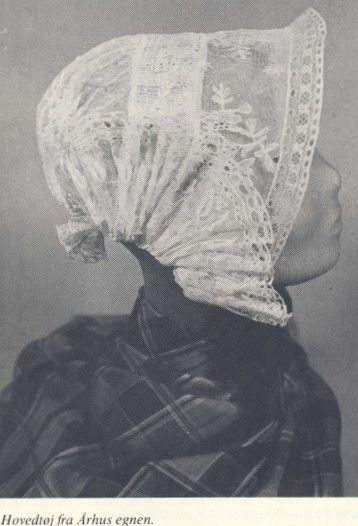
While few women in Østjylland wore the sniptøj, it appears to have been worn only in Østjylland. It is made of a large piece of stiffened linen, and has lace from the town of Tønder in front. The lace wings are sewn onto the side of the cap.
Østjylland Themes from Reviewing 50+ Folkedragt.dk Images
a. About 75% of Østjylland costumes used a red nattrøje and a bodice. The rest used a jacket (often with a matching skirt).
b. An unusually large percentage (about 25%) of Østjylland costumes used a Rococo apron, like was used in Mols.

Woman wearing Østjylland's distinctive "sniptøj" headgear
from "Danske Bønders Klædedragt" (Danish Farmers Costumes)
by Ellen Andersen, 1960

"sniptøj" headgear strikes again!
Image Credit: National Museum of Denmark
Red Østjylland


"Red Østjylland" with "sniptøj" headgear.
You can't get any more Østjylland than this! A rare stunner, this is one of Denmark's very finest. It would probably have been more common if the cost of all that lovely embroidery were not so prohibitive.
Spotted at Dansk Folkedansere Landsstævnet in Struer, 17 July 2025

Embroidery Closeup

"Red Østjylland" with "sniptøj" headgear.
Image credit: Folkedragt.dk

Østjylland 1770-1795
While this is lovely headgear, and it clearly has the lace wings, I don't see a piece of stiffened linen. Thus, I'm not sure this would qualify as a "sniptøj."
Image credit: Dávid Botond and GeoFolk

An absolutely gorgeous Østjylland costume from circa 1790-1820. Note not just the lovely embroidery but also the Danish knitting pattern on the red nattrøje sweater. Truly, the Red Østjylland costume, and this one in particular, is one of Denmark's very best.
Image Credit: Lene Bærbak Grønbech

Østjylland 1770-1795
A rococo apron, as seen above, seems to be a part of about 25% of this region's costumes.
Image credit: Dávid Botond and GeoFolk

Østjylland woman wearing sniptøj headgear.
Instead of a red nattrøje and bodice, she wears a jacket with matching skirt, which is a common Østjylland look.
Image credit: Folkedragt.dk

Østjylland costumes
Image credit: Midtjylland Museum
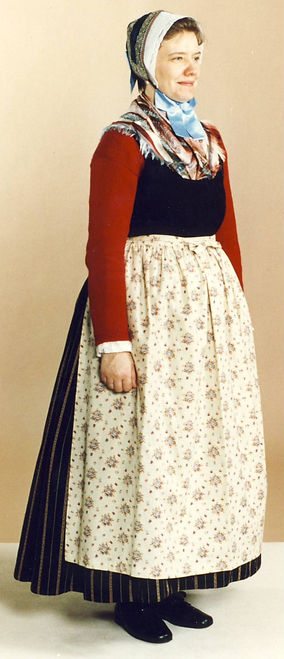


This picture is a great example of the Østjylland look, because it has:
a. red nattrøje
b. rococo apron
c. (almost a) sniptøj. While it seems to lack the stiffened linen, it has the lace wings on the sides.
Image credit: Folkedragt.dk
Silkeborg


In 1979, the predecessor organization to the Danish Folk Costume Society put on an exhibition, displaying the finest example of the Silkeborg costume.
Image credit: Folkedragt.dk
Aarhus

Århus County Outfit with "Sniptøj" Headgear
from "Danske Folke Dragter" by Nanna Gandil, 1972
The "sniptøj" headgear is the sole part of the outfit shown above that is uniquely characteristic of the Østjylland region. Notably, it consists of a large stiffened piece of linen. There is both embroidery and lace from the town of Tønder. Regarding the lace side "wings," some headgear consisted of removable wings, while other headgear had wings which were attached.
Although not uniquely characteristic of Østjylland or of Århus County, the other elements of the outfit shown above are as follows:
The skirt is made of a black base with green spots and was made with home-woven fabric. The bodice was made of black woolen twilled fabric with a shiny appearance. The bodice has a large rounded neckline with a pink brocade band at its edge. The knitted red sleeves were sewn directly onto the bodice. The apron is made of plain green silk. The shoulder scarf is a red wool tartan, tucked into the bodice in the front.


Horsens

Costumes reportedly from Horsens, Østjylland
While the images states that the clothing is from circa 1750, the man appears to be wearing an Empire period (1800-1820) short vest. Thus, it is likely that only the woman's costume is circa 1750. Note she is wearing the Østjylland sniptøj.
Image credit: Arkiv.dk
Men's Costumes
