

Amager Island

In the period 1515-1523, Denmark's King Christian II invited (for reasons not entirely known) several Dutch families to settle on the southeast corner of Amager Island in what would become the village of Store Magleby. Some say the Dutch were invited to do so because Denmark needed the canal-building expertise for which Dutch engineers were renowned. For quite some time, the Dutch Amagers did not intermarry with the Danish Amagers and did not integrate into the local community.
What we today call the "Amager" folk costume was historically the clothing worn by the Dutch Amagers who lived in the village of Store Magleby. In contrast, the Danish Amagers lived primarily in Tårnby and Dragør. As the Dutch Amagers farmed the fertile Amager soil and brought high quality produce (e.g., carrots, cabbage) to market in nearby Copenhagen, the Amager costume worn by the Dutch Amagers became associated with vendors of high quality goods. In order to cash in on this good reputation, the Danish villages of Dragør and Tårnby adopted the Amager costume, even though it was of Dutch origin. Ultimately, the farming community of Store Magleby was merged with the shipping town of Dragør in 1974.
Amager is a special region for folk costumes because its wealth and Dutch influence resulted in several unique and elaborate elements. Further, Amager women wore different costumes for different occasions, much like the women of Røsnæs and Fanø. As an example, it was said that an Amager woman needed to own no fewer than 11 aprons if she sought to have an appropriate outfit for every occasion. A man could make do with three different suits, but that was still more than other Danish regions.
Amager costumes varied in color, but not according to the seasons (as in the Hedebo Region). Instead, the costume color signified the event for which it was worn (e.g., red for church, blue for mourning).
As late as the 1930s, Amager women could be seen wearing their traditional folk costumes at the produce market in Højbro Square, Copenhagen. Fastelavn traditions have remained strong in Dragør Municipality, of which Store Magleby is a part. It is believed that those traditions served to keep the Amager costume alive through the decades. Today, these beautiful Amager folk costumes can most easily be seen during the Store Magleby Church Harvest Service and at the Museum Amager in Store Magleby.
Women's
Click the links below to jump to each costume:
1. Church suit/Kirkedragt (red apron is the most famous variant)
The red apron was actually only worn for New Year's Day, Christmas Day, Easter, Pentecost, weddings, christenings, royal celebrations and confirmations.
4. Bridal suit/Brudedragt (black or blue apron)
5. Newly Married Woman's suit/Ungkonedragt
Worn by newly married women for churchgoing and festive gatherings.
6. Chef's suit/Kokkedragt (white apron with four apron ribbons)
Worn by female relatives of the bride or groom who acted as hostesses at wedding feasts
7. Funeral and Mourning suit (black jøb with blue/white apron and two blue apron ribbons)
8. Simpler suit/Den Enklere Dragt
9. Kysedragt (white or blue apron with two apron ribbons)
10. Newer Black Party suit
11. Tårnby suit
Skirt Length
Amager and South Jutland were the only areas in Denmark where skirt lengths were a bit shorter than elsewhere.
Pleating
One of the hallmarks of the Amager women's costume is the remarkable number of pleats. Only Røsnæs's skirts have similar amounts of pleating.
Church Suit (Kirkedragt)
The beautiful Amager Church Suit contains the following elements:
a. headgear ("hjelmhue") - canvas or black velvet one-piece headgear. It had white embroidery dyed red (or indigo, which made its embroidery barely visible).
b. blouse - black silk (often damask) with velvet panels
c. On her chest, she wears a large gilded buckle/medallion to fasten the blouse, featuring images of the Virgin Mary.
d. The owner's metal initials hung below this medallion
e. "Barcelona scarf": silk or velvet scarf/shawl with silk embroidery
f. apron - red deeply pleated wool (only used for church services) over a black deeply pleated skirt
g. In her hand, the woman would carry a handkerchief, so stiffened with starch as to be unusable and dyed dark blue, attached to a large tassel decorated with multicolored beads.


Kirkedragt on display at Museum Amager
It is almost certainly the finest kirkedragt of all. The scarf embroidery is utterly jaw-dropping! These Nikon images bring out the detail.
Image Credit: DanishFolkCostumes.com

Medallion
Image Credit: Amagerdragterne by Birte Hjorth, 1996


A lovely woman displaying an absolutely stunning kirkedragt seen at the Store Magleby Church for their annual Harvest Service on 13 Sep 2026. The Amager kirkedragt must certainly be on anyone's short list for most beautiful folkdragt in Denmark!
Image Credit: DanishFolkCostumes.com
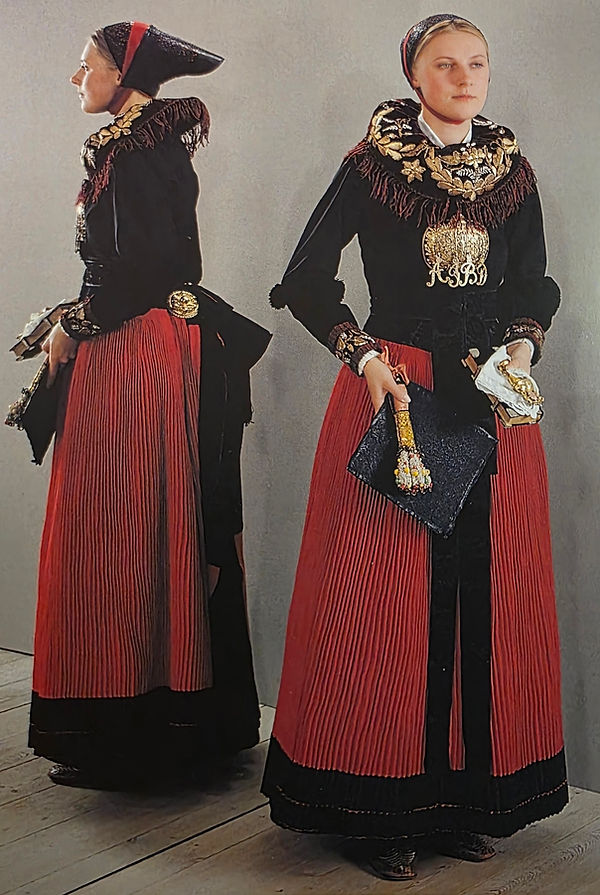
Image Credit: Amagerdragterne by Birte Hjorth, 1996

Amager wool church bodice with silk ribbon trim and sewn-on black nattrøje sleeves knitted in a traditional star-pattern
Image Credit: Museum Kolding

Amager wool church apron with black velvet trim. Decorative brass plates.
Image Credit: Museum Kolding
Party Suit/Festdragt
The Party Suit/Festdragt was worn for parties in Store Magleby. It had a pleated wool apron. By the late 1800s, it was replaced by the City Suit because hand-pleating a dyed wool skirt became too labor-intensive.
Elements of the Festdragt:
a. Skirt - deeply pleated black wool
b. bodice - silk brocade, damask or velvet
c. shirt - white linen with lace-trimmed sleeves
d. apron - deeply pleated black wool
e. headgear ("hjelmhue") - seemingly identical to that worn in the kirkedragt
f. silver - silver eyelets laced by a silver chain
g. Barcelona scarf - silk with silk embroidery

Amager Festdragt
Image Credit: Amagerdragterne by Birte Hjorth, 1996

Image Credit: Amager Museum
City Suit/Stadsdragt
The Amager city suit (stadsdragt) was worn to go into Copenhagen. It used black cloth (often damask silk) of the finest quality. Around 1800, a black dress was not viewed as being gloomy. Basically, it was a festdragt with a flat apron and slightly different headgear.
Elements:
a. apron is made of black silk, usually damask. Thus, the apron was flat or lightly gathered to show off the fabric.
b. Around the waist was a black duchesse ribbon with colorful embroidery.
c. scarf - Amager sailors brought the shoulder scarf, the very large silk "Barcelona scarf," home to their wives and girlfriends, who then set about embroidering it with colored silk threads. Women had multiple scarves, as one was needed for celebrations, while others were required for mourning.
d. Headgear - The so-called "duckbill" ("andenæb") headgear protruded with the help of a cardboard insert, and consisted of one piece of black velvet. It was embroidered in white which was then dyed indigo.
e. On the chest are 4 pairs of discs covered thinly (i.e., gilded) with silver. The eyelets on the discs are laced together with a flat, wide needle attached to a long silver chain.

Amager Stadsdragt (City Suit)
from "Danske Folke Dragter" by Nanna Gandil, 1972
Bridal Suit
The Bridal Suit is basically a Kirkedragt with special elements:
a. red headgear with silver or gold metallic embroidery, or sometimes a metal crown
b. blue pleated wool apron
c. gold belt

Image Credit: DanishFolkCostumes.com courtesy of Museum Amager

Amager Bride from Dutch town of Store Magleby, wearing bridal headgear
%20in%20wedding%20dress.jpg)
A woman from West Sundby ("Sundbyvester"), Amager, in wedding dress
By the late 1800s, changing fashions resulted in brides favoring the more "modern" non-pleated black damask apron

Newly Married Woman's suit/Ungkonedragt
This costume was worn by newly married women during their first year of marriage.
The Ungkonedragt is basically a Festdragt with special elements:
a. apron - white deeply pleated linen instead of red deeply pleated wool
b.

Image Credit: Amagerdragterne by Birte Hjorth, 1996
Chef's Suit (Kokkedragt)
The so-called chef's suit costume was worn at a wedding celebrations by relatives of the bride or groom who were hosting those celebrations. It is basically an Ungkonedragt with double the number of ribbons in front.
Elements:
a. Note that it has four apron ribbons, not the usual two.
b. "Barcelona scarf" and round pins/ornaments that are thinly-coated (gilded) in silver.
c. apron - white deeply pleated linen
d. Barcelona scarf - silk embroidery on a silk scarf
e. married headgear - married women wore the same headgear as on the kirkedragt and festdragt ("hjelmhue")
f. unmarried women wore the krave headgear, which featured the distinctive red nakkepølse, a symbol of maidenhood

Image Credit: Amagerdragterne by Birte Hjorth, 1996

Amager Kokkedragt (Chef's Suit)
Funeral/Mourning Suit

Image Credit: Amagerdragterne by Birte Hjorth, 1996

Funeral/Mourning Suit

Mourning Suit
The fan-shaped element at the rear was stiffened with cardboard and covered with colored silk. Across Denmark, women mourned by putting their outermost skirt over their heads, however, this fan was unique to Amager.
Image credit: "Folkedragter" by Minna Kragelund, 1978

Amager Funeral/Mourning Costume 1870-1880
from "Folkedragter i Danmark" by Ellen Andersen, 1952
At funerals until the 1880s, women in Store Magleby and Dragør wore black skirts, called a jøb, which could be pulled over their heads in order to hide their grief. In earlier times, the skirt was worn over the head even in church, and priests complained bitterly that the women were seizing the opportunity to nap. The Amager jøb has a cardboard "peacock tail" at the back, which is covered with wine-red and blue silk cloth. The mourning apron is white with a blue band at the top.
Simpler Suit (Den Enklere Dragt)
Women with less money wore the Simpler Suit. It lacked the metal disks and silver chain. It could be worn to market if selling produce in Copenhagen.

Image Credit: Amagerdragterne by Birte Hjorth, 1996

Image Credit: Amagerdragterne by Birte Hjorth, 1996


Amager was associated with the growing of carrots (and other vegetables). That reputation was enhanced by a H.C. Andersen poem and a children's nursery rhyme, both of which speak of Amager women and carrots.

Amager Market Dress
Kysedragt
Denmark fights back! :) The Kysedragt is a Danish adaptation of the costumes worn by the Dutch Amagers in Store Magleby.
On Amager Island, Dragør is the non-Dutch town right next to the Dutch village of Store Magleby. The Dragør Kysedragt is a Danish modification of the Dutch costumes from Store Magleby. Specifically, the Dragør Danes replaced
1. the silk Barcelona scarf with an alpaca shoulder scarf.
2. the densely pleated Dutch aprons with a "regular" white cotton apron, and
3. the hjelmhue with the kyse headgear.
It has the following elements:
a. large white cotton apron with numerous folds (but NOT deeply pleated)
b. Two ribbon strands (the Kokkedragt has four)
c. shoulder scarf is made of alpaca wool and richly embroidered with flowers of sheep wool yarn and with a fringe at the edges.
d. a white scarf was worn between the embroidered scarf and the neck to protect the embroidery.
e. a kyse bonnet made of either velvet or silk over a cardboard form. It is open at the back so you can see the small silk hat underneath.


A beautiful example of the Kysedragt, seen at Store Magleby Høstgudstjeneste (Harvest Service) 2026
Image Credit: DanishFolkCostumes.com


Image Credit: Amagerdragterne by Birte Hjorth, 1996

Kysedragt from Dragør, Amager Island
This costume photographed is an original from the 1800s.
Image Credit: "Danske Folke Dragter" by Nanna Gandil, 1972


A lovely example of a Kysedragt circa 1870
Worn by none other than the President of the Danish Folk Costume Society!
Image credit: Dávid Botond and GeoFolk

The costume in the middle appears to be a city suit worn with kyse headgear and kysedragt apron.
The two ladies on either side are wearing kysedragt.
Image credit: Amager Folkedansere

Alpaca Scarf worn as part of the Kysedragt
Tårnby Dragt
Denmark fights back yet again! :) The Tårnby Dragt is a Danish adaptation of the Stadsdragt worn by the Dutch Amagers in Store Magleby. On Amager Island, Tårnby is the non-Dutch town north of the Dutch village of Store Magleby.
Specifically, the Tårnby Danes took the Stadsdragt and did the following:
1. no ribbons!
2. the metal eyelet plates are not round
3. metal buckle below the eyelets
It has the following elements:
a. lightly pleated silk apron with numerous folds (but NOT deeply pleated)
b. shoulder scarf is made of silk
c. headgear - duckbill ("andenæb"), like the stadsdragt

Image Credit: Amagerdragterne by Birte Hjorth, 1996
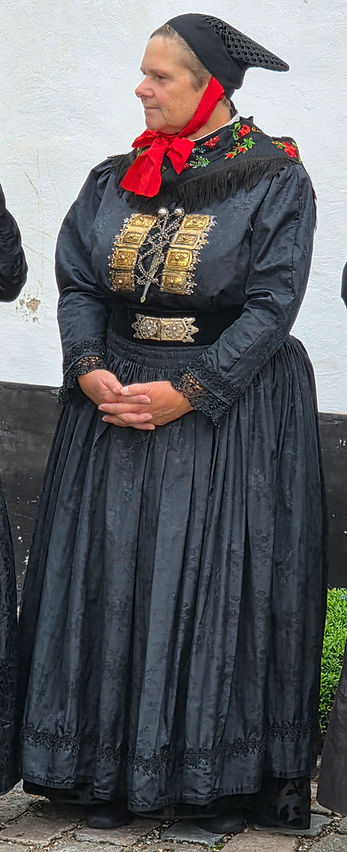
Image Credit: DanishFolkCostumes.com
Other Amager Images

This hi-res image shows the stunning Amager costumes on display at the Amager Museum following the Store Magleby Harvest church service. Just gorgeous! The red church apron with its many pleats is remarkable.
Image Credit: Amager Museum


Amager Costumes in Dutch Town of Store Magleby


Amager Dutch Floss Hat ("floshat"), also called a "thrum hat," is incorrectly said to be made of camel wool. However it is actually made from the hair of an angora goat. The misunderstanding comes from the fact that the arabic name for the angora goat is "seil el kemel," prompting people to incorrectly assume a camel was involved.
Image Credit: Amager Museum

Amager Dutch Groom from Hollaenderbyen, 1892

1908: Amagerkoner (Amager wives) on Højbro Plads in Copenhagen selling vegetables and flowers while wearing elements of their traditional folk costume. In this respect, they are not unlike the women from Skovshoved who sat at the Gammel Strand fish market in their traditional woodland costume and sold plaice caught by their husbands in the Øresund.

Amager women at Israels Plads, Copenhagen, 1930


Amager woman in market dress on display at National Museum. She is wearing the rare Amager stiffened canvas market hood ("strammede lærredshat"). It is rarely seen because photos and images focus overwhelmingly on festive or celebratory attire, not utilitarian weather-protective workwear.

Left: Amager Wedding Dress
Right: Amager Church Suit (Kirkedragt)
Amager and Røsnaes were two places in Denmark where for a long time it was held that women wore different suits for different occasions.
Image Source: Mikael Bjerregaard
Men's
Amager has two men's costumes:
a. Dutch Amager Suit with Blue Floshat
b. City/Church Suit with Top Hat
.jpg)
Two sharp-dressed gentlemen wearing the famous blue floshat and Amager men's suit. As this suit comes from the Netherlands, it should come as no surprise that there is a similar looking Dutch folk costume. Seen at Store Magleby Church during their annual Høstgudstjeneste (Harvest Service) 2026.
Image Credit: DanishFolkCostumes.com

Seen in Kalundborg, 2026
Image credit: DanishFolkCostumes.com

Amager mens costume
Note the unusual white knit cap. Interestingly, regarding the color of men's knitted caps, Joachim Junge, writing in his 1915 book "Den Nordsjaellandske Landalmues Karakter" states that men in Frederiksborg County (basically Sjælland near Hillerød and Helsingor) wore white caps, while residents of nearby "Hirschholms County" (a small county near Hørsholm) wore red caps. The use of white caps seems to have been relatively uncommon in Denmark.
Image credit: Amager Folkedansere

Amager mens costume
Image credit: Amager Folkedansere

Amager Man Costume 1830-1840
from "Folkedragter i Danmark" by Ellen Andersen, 1952
The unusual men's "Dutch floss hat" was made of the hair of an angora goat and weighed 10lbs. The man wore two shirts, a white undershirt and a red cotton shirt above. He wore a black cloth waistcoat. Around the neck was a folding collar of finely wrinkled and blued canvas, which was a remnant of the elegant ruff collars worn by wealthy men during the Renaissance and still worn by Danish priests to the present day. Over the collar was a silk scarf. Distinctively, Amager men wore baggy black trousers, which were also a fashion holdover from the Renaissance.
