

Men's Costumes
Unlike women's costumes which generally come from a particular region within Denmark, men's costumes were rarely limited to a particular region.
However, there are a few men's costumes that "belong" to a particular region, and are therefore quite special (click the name to go to the page):
a. Lyø: Wow! A unique color palette of olive green and coral pink. Plus, the festive Nikolør's hat!
b. Horne: Double wow! Horne's hypnotic dazzle of crimson red, navy and yellow will cast a spell over you! If Lyø is a neon sign, Horne is a neon sign in Times Square. Brash and unapologetic, this costume is the splendid proud peacock of men's attire.
c. Ærø: Perhaps the most handsome and elegant combination of colors (navy blue and orange!). Unusually for Denmark, the breeches are dark blue instead of white/cream.
d. Fanø Skipper: It's not every day that you see a banana yellow damask Victorian Era vest with brown velvet pants. No one could ever confuse this costume with any other Danish region.
e. Randers: Distinctive in the way the silver buttons wrap under the pockets.
f. Amager: If Lyø, Horne and Ærø are collectively unique and unusual, the Amager men's costume is as if from another planet! With its Dutch-influenced baggy trousers and blue hat of "camel" (actually angora goat) hair, it is otherworldly, and in a good way. It is a striking costume that speaks of bonds with the Netherlands going back to 1520. Even when Amager men wore a "regular" floppy knit cap, they and Nordsjælland were some of the only regions to wear one that is white!
g. Haderslev: The horizontal yellow Empire Period vest stripes are bold and sharp-looking, and present a dashing military-esque appearance reminiscent of Denmark's famed Royal Horse Guards. This pattern proudly proclaims one's
Sønderjylland heritage!
h. Hedebo: The men's red Hedebo vest is elegant and instantly recognizable. It does not attempt to outshine the women's Hedebo costume but rather complements it.
i. Røsnæs: The distinctive and handsome blend of dark colors in the men's vest creates a lush hue of indigo and violet that really "pops." A real winner of a pattern.
j. Lolland: A vest resembling that from Hedebo, but even more distinctive. The costume for the discerning man who wants to be a bit individualistic.
k. Thy: An immediately recognizable and distinctive green-and-red vest that is not seen as often as it deserves. The Thy vest is a handsome pattern that is surely difficult to weave.
Men's Pants 1700-1848:
[Text credit: "LG" of Danish Folk Costume Society, 1991]
Around 1800, there was a radical change in men's folk fashion across Europe as Empire Period fashions were embraced. The long vest and breeches were replaced by short vests with a high collar, and long trousers. Perhaps surprisingly, in both the 1700s and 1800s Denmark, the most common type of fabric used for trousers was leather(!), followed by wadmal wool, "cloth," homemade canvas and velvet. Velvet became significantly more popular in the 1800s.
1700s men's pants:
leather 60%
wadmal wool 16%
canvas 18%
velvet 7%
1800s men's pants:
leather 39%
wadmal wool 20%
canvas 12%
velvet 29%
Long trousers:
They first appeared in Danish deed records for the first time in 1801 when a pair of canvas riding trousers was mentioned. Of the 300 pairs of men's pants recorded in deed records between 1800 and 1848, at least 21 were long. Of those 21 pairs:
canvas: 4 (1801-1819)
blue wadmal wool: 5 (1819-1832)
velvet: 8 (1817-1831)
"blue": 3
"black": 2
"green-striped": 1
no color specified: 2
Additionally, brown riding breeches: 2 (1825) (presumed to be long)
Etiquette Rules for Men's Jackets
In the folk costume era, wearing a jacket over a vest was considered appropriate indoor attire, just as wearing a suit jacket would be today. Even though folk costume jackets are made of thick wool and very warm, homes and churches were not particularly warm back then. Outdoor attire, if needed, consisted of either a cloak or a greatcoat, which was not worn indoors.
Etiquette Rules for Men's Hats
As a general rule, stiff brimmed hats (usually black) were only worn outdoors. Indoors, a floppy knitted hat was worn for warmth. While traveling outdoors, the knitted cap was either carried in a pocket of the greatcoat or was instead tucked into the waistband of the breeches. If quite cold outdoors, the knitted cap was worn underneath the stiff-brimmed hat.
When Did it Become Socially Acceptable to Appear "Bareheaded"?
Indoors: 1860s-1970s
Outdoors: 1930s-1960s
Prior to this cultural switch, appearing bareheaded was a sign of poverty.

1770-1795
Image credit: Dávid Botond and GeoFolk

1770-1795
Image credit: Dávid Botond and GeoFolk

1795-1804
This vest sports the flowerpot pattern for which Salling is famous.
Image credit: Dávid Botond and GeoFolk

1820-1835
Image credit: Dávid Botond and GeoFolk

1820-1835
Image credit: Dávid Botond and GeoFolk

1820-1835
Image credit: Dávid Botond and GeoFolk
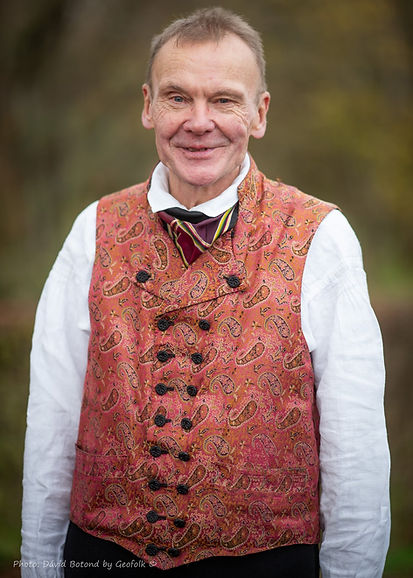
1835-1870
Image credit: Dávid Botond and GeoFolk

Tåsinge man, circa 1770
While this is reportedly a costume known to have been worn on Tåsinge Island, it was also worn by men all over Denmark. This suit is dark blue, not black.
Image credit: Folkedragt.dk

