

Swedish Military Uniforms
Hussar Regiments
Sweden had several types of cavalry uniforms, but its hussar cavalry were arguably the most dashing., Specifically, the "hussar m/1895" ceremonial parade dress uniform, is one of the finest and most handsome military uniforms in Europe.
While the hussar m/1895 is no longer worn by any active regiment, the K3 Life Hussars regiment is still "permitted" to wear it as a ceremonial uniform. It is very likely to have been worn by the color guard at the 7 March 2022 Karlsborg Fortress event where the K3 regiment was issued its first new regimental standard (flag) since 1968.
Historical reenactors keep this glorious uniform tradition alive by wearing the hussar m/1895's of regiments K3, K4, K5 and K7 on horseback at festivals in southern Sweden to the delight of spectators.
In contrast, the Danish Guard Hussars do still wear the hussar ceremonial parade dress (with red pelisse) about once per year in early January. While wearing it, they are real soldiers, albeit on parade. Thus, civilians are not permitted to wear that uniform without the permission of the Danish military.
Hussar Regiments
Uniform Rules Generally Applying to all Hussar Regiments
Dolman jacket: dark blue for all regiments (except K1 1814-1820 and K3 1791-1833 wore medium blue)
Dolman braiding: 20 horizontal braids until m/1870 uniform; thereafter, 10 braids
Pelisse fur-lined coat: dark blue (all hussar regiments except K3 1791-1833; no longer used as of 1875).
Riding breeches: yellow (all regiments, until 1845), then dark blue
Riding overalls were often worn over breeches as they were considered fancier for parade dress.
Boots:
Hessian (tassel + v-cut) until 1854
Short boot worn with long trousers until 1895
Tall stiff straight-top black leather 1895-Present
K1 Mounted Life Guards
K1 changed their uniform more than any other regiment.
From 1806-1845, K1 was a hussar regiment and wore a hussar uniform.
Uniform
Dark blue collar, yellow braids 1820-1845
Headgear
busby (husarhögmössa) with medium blue "busby bag" 1806-1820
two-tone busby (husarhögmössa) with dark blue busby bag with yellow edging 1820-1845
K3 Life Regiment Hussars
Formed 1791 and still in service! However, on 31 Dec 1927 K3 was reorganized and lost its horses, becoming a recon regiment.
Uniform: White collar, white braids (except black braids 1875-1895)
Officers wore silver braids.
Pelisse: white 1791-1833
Garrison locations: Örebro/Skövde/Karlsborg Fortress
Troops were raised from Närke Province and Skaraborg County (Northern Västergötland). Part-time farmers.
Headgear
white plume
busby (husarhögmössa) with yellow "busby bag" 1791-1810
shako 1810-1895
busby with white "busby bag" 1895-1927
K4 Småland Hussars
Formed 1822; Disbanded 31 Dec 1927
Uniform: Yellow collar, yellow braids (except black braids 1875-1895)
Officers wore gold braids.
Garrison location: Eksjö, Småland
Troops were raised from Småland. Part-time farmers.
Headgear
busby (husarhögmössa) with yellow "busby bag" 1822-1833
shako 1833-1895
busby 1895-1927
K5 Skåne Hussars
Formed 1807; Disbanded 31 Dec 1927
Uniform: Medium blue collar, yellow braids (except black braids 1875-1895)
Officers wore gold braids.
Garrison location: Helsingborg, Skåne
Troops were raised from Skåne. Part-time farmers.
Headgear
busby (husarhögmössa) with yellow "busby bag" 1807-1816
busby (husarhögmössa) with medium blue "busby bag" 1816-1832
shako 1832-1895
busby 1895-1927
K7 Crown Prince Hussars
Formed 1822; Disbanded 31 Dec 1927
Uniform: Dark blue collar, yellow braids
Officers wore gold braids.
Garrison location: Malmö, Skåne
Troops were raised from across southern Sweden. Full-time professionals.
Headgear
black plume
busby (husarhögmössa) with yellow "busby bag" 1822-1833
shako 1833-1895
busby 1895-1927
K2 Skåne Cavalry Regiment (1928-1942)
In 1928, K4, K5 and K6 (Skåne Dragoons) were consolidated into the K2 Skåne Cavalry Regiment. In 1942, K2 was reorganized into P2 Skåne Armored Regiment, and horses were finally replaced with tanks.

K1 (Mounted Life Guards) circa 1820-1823.
Uniform elements:
a. busby (husarhögmössa) hat with dark blue "busby bag" with gold edging and white plume. While the bag may look like a medieval liripipe (designed to convey fashion and status), the busby bag was originally designed to be filled with sand and attached to the shoulder to protect against sabre cuts. By 1840, the busby bag would become largely ceremonial and decorative.
b. The pelisse would be discarded as of the debut of the hussar m/1875 "Attila" uniform.
c. dolman jacket with dark blue collar with gold edging. The hussar dolman jacket was no longer in regular use once the unit was reorganized on 31 Dec 1927. Instead, it was "permitted" for ceremonial use only and continues to be until the present day.
d. These soldiers are wearing riding overalls.

K1 (Mounted Life Guard) in m/1820 (worn 1820-1824) uniform with busby (husarhögmössa) hat. He is wearing leather-reinforced overalls.
Confusingly, his plume is yellow instead of white, but perhaps that is because he is an officer (note the decorated collar).
Image credit: Hans Högman

Reenactors wearing:
a. Yellow/buff breeches (worn until 1845)
b. 10-braid dolman with yellow braids (1895-1927)
c. K-1 (Mounted Life Guard) two-tone Busby (husarhögmössa) hat with "busby bag" (worn 1820-1845)
It looks great, and I commend them for their efforts to educate and entertain audiences!

K3 (Life Regiment Hussar) Ceremonial Dress Dolman (3 stars on collar = colonel) still used today. This m/1895 uniform indicates that officers wore silver braids, not white.

This is an AI-generated image of a K3 (Life Regiment Hussar) wearing the m/1895 uniform which is still "permitted" for ceremonial dress. It might be seen at Karlsborg Fortress on Regiment's Day (Regementets Dag) celebrations around May 19th each year. An even more likely event would have been 7 March 2022 when the King presented the K3s with their first new regimental standard (flag) since 1968. Active K3 soldiers in the color guard would have likely worn the m/1895 K3 uniform for an event of tremendous significance to the K3 regiment.
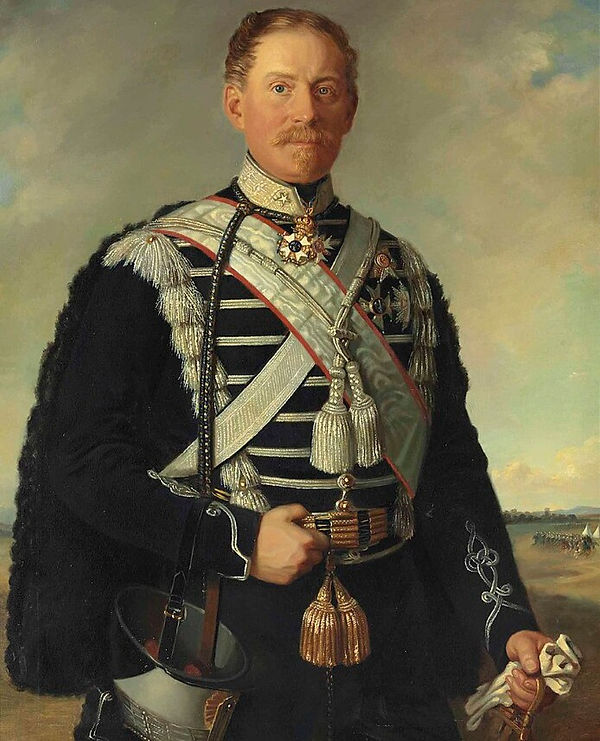
K3 (Life Regiment Hussar) General's uniform circa 1855-1862. The tassels on the dolman's buttons indicate that this dolman is pre-1875 (when the Attila dolman was introduced)
.jpg)
K3 (Life Regiment Hussars) in m/1870 uniform identifiable by white or silver braids, seen with fur-lined pelisse

K3 (Life Regiment Hussars), circa 1860s. Officers had silver braids, while enlisted men had white braids. The man on the left is a bugler, so he wears a musician's insignia on the shoulders of his jacket.

K3 (Life Regiment Hussar) medium blue uniform, wearing riding overalls and white pelisse (worn 1791-1833).
The problem is that the two-tone husarhögmössa hat shown was only worn by K1 (Mounted Life Guards).
Image credit: Drabant Design
.jpg)
Småland Hussar K4 m/1872 uniform, seen with fur-lined pelisse. This is a rarely seen uniform, existing only from 1870 (when braiding went from 20 to 10) until 1875 when the pelisse was abolished.

Småland Hussar K4 (yellow collars) reenactors in m/1895 uniform.

Skåne Hussar K5
Image credit: Drabant Design

Skåne Hussars K5 (medium blue collars) reenactors
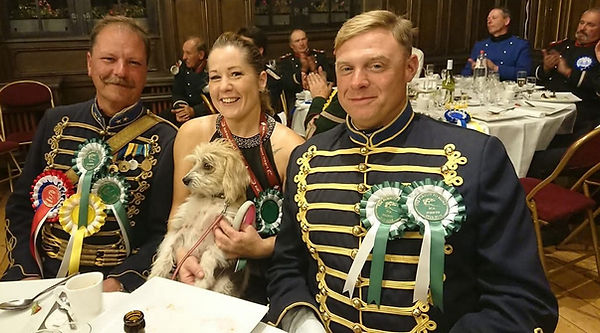
K7 Hussar reenactors competing in a 100km equestrian ride called The Pursuit to Mons, celebrating the 100th anniversary of the final cavalry offensive of WW1 (in 1918). It was sponsored by the International Cavalry Association. Swedish riders were allowed to participate, even though Sweden was neutral during WW1. Riders of any nation could participate, but they were required to wear the uniform of their nation's cavalry from 1918.

K7 Hussar dolman m/1895

K7 Crown Prince Regiment (dark blue collar). Uniform is m/1895.

The bright yellow "flaps" on the shoulders indicate that this uniform was worn by a member of the cavalry band.
Life Guards Regiments
As of the present day, there are three Life Guard regiments, with the cavalry (dragoons) wearing a markedly different uniform from the other two.
a. Life Guards Grenadier Regiment - dark blue tunic (m/1886) and "bearskin" hat
b. Life Guards Svea Regiment - dark blue tunic (m/1886) and pickelhaube helmet
c. Life Guards Mounted Dragoon (K2) - medium blue tunic (m/1895)

A forlorn-looking Life Guard Grenadier. They are distinguished by their tall "bearskin" hats made of synthetic nylon.

Life Guard Svea Regiment. They are distinguished by their pickelhaube (m/1887) helmet with white buffalo hair. Only Svea has epaulets that feature the monogram (in silver) of the reigning monarch.
.jpg)
Life Guards Mounted Dragoons (K2). They are distinguished by their pickelhaube (m/1887) helmet and white collars. You may see this regiment at the daily Changing of the Guards in Stockholm. In 1845, K1 adopted this "medium blue" uniform to stand out as the monarch's personal soldiers compared to the dark blue of other regiments. Subsequently, in 1906 when Sweden had just split with Norway and was looking for a new shade of blue for the national flag, this "medium blue" K1 shade was chosen because it was deemed to be distinctly Swedish.
Why did K1 adopt a medium blue color? King Oscar chose the shade in 1845. He was the son of French Marshal Bernadotte. He may have favored the medium blue shade of the French chasseurs which was fashionable in Europe at the time.

Life Guard Horse Drabants (without horses, obviously) in the m/1695 uniform with cuirass armor. They were seen at the 1974 Opening of Parliament.
