

Drejø Island

Overview
Drejø Island has a population of approximately 65 people today. The economy is based upon dairy farming.
The folkedragter (folk costumes) of the island of Drejø, situated in the heart of the South Funen Archipelago (Sydfynske Øhav), are celebrated for their vibrancy and preservation of 18th-century silhouettes. Because Drejø was historically a wealthy "skipper island" with fertile land, its inhabitants had the means to decorate their clothing with expensive dyes and imported fabrics, creating a style that is both quintessentially Danish and uniquely insular.
Cultural Distinctiveness and Influences
Drejø’s culture was defined by its autonomy and the "Golden Age" of Danish agriculture and local shipping. The islanders were known for being relatively affluent compared to the mainland peasantry, which allowed for a "competitive" display of wealth through clothing.
The primary influence on the Drejø costume was the Rococo and Biedermeier styles of the 18th and early 19th centuries. While the mainland began to adopt mass-produced fabrics earlier, Drejø maintained a tradition of high-quality, hand-loomed wool and professional silk embroidery. The island's geography—isolated but within sailing distance of the major market town of Svendborg—allowed for a "controlled" evolution of fashion where trends were adapted but never fully replaced the traditional local structure.
Usage as Daily Wear
The Drejø costume flourished between 1770 and 1880.
-
Daily Wear: Simple linen shifts and woolen skirts were the norm until the mid-1800s.
-
Festive Wear: The high festive attire remained a standard for island weddings and "Høstgilde" (harvest festivals) well into the late 19th century. Unlike the border costumes of the Dannevirke, which were political, the Drejø folkedragter was an expression of local pride and familial status.
Modern Observance
Today, the Drejø costume is a focal point of the island's local museum (Drejø Museum) and is frequently worn during the island's annual summer festivals and by folk dance groups from Svendborg that specialize in South Funen traditions.
Women's Costume
The Drejø women's costume is famous for its "Madder Red" tones, the elaborate structure of its bodices, and its distinctive headgear. On Drejø Island, women wore blue for Christmas, green for Easter and red for Pentecost.
-
Shirt (Særk): A fine white linen shirt with "Hvidsøm" (white-work) embroidery. The sleeves are voluminous, often gathered at the elbow or wrist with a delicate lace edge.
-
Skirt (Skørt): The most common color for festive occasions was a deep red wool. On Drejø, these skirts were often very heavy and pleated at the back to create a full, rounded silhouette that emphasized the wearer’s hips.
-
Apron (Forklæde): Usually a dark, shimmering silk with woven floral patterns. For church use, a white linen apron with "Hulsøm" (hemstitching) was preferred.
-
Blouse/Bodice (Livstykke): A very short-waisted, tight-fitting bodice made of silk damask. It was often green or blue to contrast with the red skirt, creating a "complementary" color scheme that is iconic to the island.
-
Jewelry (Smykker): * The Brooch: A silver or silver-gilt "Solvje" with dangling leaf pendants.
-
Necklace: Often a silver "Slangekæde" (snake chain) or garnet beads.
-
-
Headgear (Hovedvandt): The island's most distinctive costume element is the headgear, which is a variation of the "Guldnakke." The headgear consists of a small cap (black if married, otherwise red) with starched linen over it. The cap has a hard back covered in gold embroidery and gold sequins, often finished with a large, stiffly starched white lace "wing" (Pibekrave) that stood out horizontally from the head. There is almost always lace at the front of the headgear. There is a silk bow at the chin and another bow at the back of the headgear. [Rasmussen, Danske Folkedragter, 1942].
-
Scarf (Tørklæde): A silken shawl, usually with a dark background and bright floral prints, folded and pinned to show the silver brooch at the center.
Men's Costumes
The men’s costume on Drejø is a classic representation of the Danish Skipper-Farmer. Its unique twist is the vertically-striped brown-and-black long trousers!
-
Shirt (Skjorte): White linen with a high, standing collar and silver studs at the throat.
-
Trousers (Bukser):
-
Supposedly, dark blue wool breeches (Knæbukser), fastened at the knee with three silver buttons. White wool stockings were worn for festivals.
-
It is worth noting that there are two images (below) of a Drejø man in long, vertically striped trousers (seemingly brown and black). These unique striped trousers are not seen elsewhere in Denmark.
-
-
Waistcoat (Vest): Often a bright red wool or a striped silk, featuring a double row of silver-plated buttons set very closely together.
-
Jacket (Trøje): A short jacket in dark blue wool, allowing the colorful waistcoat to remain the visual center of the outfit.
-
Headgear: A black "Skorstenshat" (top hat) for high holidays or a knit "nathue" (nightcap) with a tassel for everyday use, typically the "Nikolor's" striped knit hat, not solid red.
Comparison and Heritage
The Drejø costume offers a perfect snapshot of the stylistic variations within the Danish archipelago.
-
Versus Other Archipelago Islands (e.g., Ærø or Lyø): While neighboring islands share the "Guldnakke" headgear, Drejø's costume is often noted for being more "archaic." It retained the 18th-century bodice lacing and heavy wool pleating longer than Ærø, which adopted more modern, urbanized Funen fashions earlier due to its larger maritime ports.
-
Versus the Funen Mainland: The mainland folkedragter (from Odense or Assens) tended to be more "sober" and followed the dark-colored trends of the mid-19th century faster. Drejø’s costume is far more colorful, clinging to the reds and greens of the previous century as a mark of island distinction.
-
Insular Pride: The Drejø costume stands out because it reflects the "Island Mentality"—it is a costume designed to be seen from a distance, with bold colors and shimmering gold embroidery that announced the prosperity of the island to any visitor arriving at the harbor.
Women's Costume

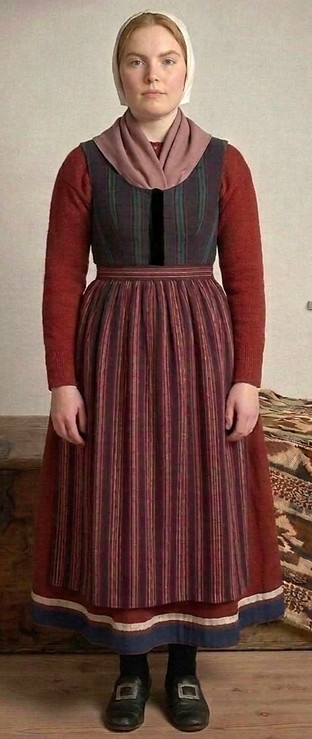
This is the official Drejø costume, based on actual items in the National Museum and assembled by former costume director Ellen Andersen in the 1960s. In her 1952 book, she describes the above as the "Red Pentecost Costume." The above image is an AI composite based on the individual costume elements selected by the National Museum as representing the best known items from Drejø. Thus, put together, they represent the official women's costume of Drejø (there is no official men's costume). The items chosen by the Museum are the headgear (with pink ribbons), bodice, skirt and apron. I had AI insert the red nattrøje and scarf, as they are not unique to Drejø.
In the 1960s, the National Museum selected 100 costumes from its collection. Some of the 100 were assembled from component pieces, like the costume above. These "official 100" costumes were then painstakingly copied and documented in Ellen Andersen's book, Folkedragter i NationalMuseet. Then, they were given to Danish folk dance groups to be used and further copied.

The bodice from the National Museum's collection that was selected by curator Ellen Andersen as Drejø's very best. As such, it forms part of the official Drejø women's costume.

The skirt from the National Museum's collection that was selected by curator Ellen Andersen as Drejø's very best. As such, it forms part of the official Drejø women's costume.


The apron from the National Museum's collection that was selected by curator Ellen Andersen as Drejø's very best. As such, it forms part of the official Drejø women's costume.


The headgear from the National Museum's collection that was selected by curator Ellen Andersen as Drejø's very best. As such, it forms part of the official Drejø women's costume.
View these items at the National Museum for yourself at:
https://samlinger.natmus.dk/objectbrowse?media=image,pdf,rotation&keyword=1047

The above photo was taken in 1939 at the Old Parish Bailiff Farm (Gamle Sognefogedgaard) before it burned down in 1942. Sadly, most of Drejø's folk costumes were stored at that farm. Thus, they were destroyed in the fire. A few costumes still exist and are shown on this page and can be seen at the National Museum's online collection.


Drejø Easter (left) and Pentecost (right) Costumes, 1860-1870
from "Folkedragter i Danmark" by Ellen Andersen, 1952
Easter Costume: The girl on the left, above, is wearing a green Easter costume. Her bonnet/headgear is lavishly studded with piped frills and twisted silk ribbons. Her lace headgear is an imitation of those worn by the upper class. She is wearing a so-called "block cloth" apron, which is relatively unusual.
Pentecost Costume: The girl on the right, above, is wearing the red Pentecost costume. Her headgear is of an older style, as it possesses a wire which holds the lace out from the head like a halo. It seems as though the girl is wearing the official Drejø costume as selected by the National Museum, with the exception of her headgear.

Married woman from Drejø
from "Danske Nationaldragter," 3rd Ed. (1915)
by F.C. Lund with illustrations by Luplau Janssen


Image Credit: Midtjylland Museum

Drejø printed bodice fabric closeup
Image Credit: "Folkedragter" by Minna Kragelund, 1978

Image credit: Mikael Bjerregaard
Men's Costume
It seems that there may be more than one Drejø men's costume, but the one that is most likely authentic is the one pictured below (striped long trousers and striped Nikolor's cap like was also worn on Ly)

Motif drawn by Eyvind Hansen for Lise Porcelain

Hjallese Folk Dancers, 1964
This is speculated to be the men's Drejø costume, as it matches the drawing above, which appeared on a porcelain plate as part of a folk costume series.
Image credit: Arkiv.dk

I think this is the best look at the men's vest and jacket. Unfortunately, the long trousers are not striped.

Drejø, 1840
The model for this suit wears a vest from Drejø held at Møntergården in Odense. This pattern of vest was reportedly not specific to Drejø, as it was used all over Denmark. Some were sewn from fine purchased fabric while others were made from hvergarn like this one. Almost all vests from 1840 had a brown glossy canvas back. Long trousers were common in the 1840s. Regarding headgear, a red knit cap was still common throughout the Danish countryside. Men often wore jackets over their vests both indoors and outdoors. If outdoors, a black felt top hat would adorn the head.
Text credit: "IE" from Danish Folk Costume Society, 1991
Image credit: Licensed from Folkedragt.dk

Image credit: Frederikshavn Folkedansere

