

Nordsjælland Region
(Frederiksborg County)


Women's Costumes
The Nordsjælland (North Zealand) costume has two distinctive elements which have survived:
a. "golden neck" bonnet: It is highly ornate and quite beautiful (below).
b. apron: A distinctive apron in "star and goose eye" pattern (stjerne og gåseøje). Notably, it is frequently made of either linen or linen and wool.


Image credit: Marie Wolter Bertelsen

Costume from Hillerød
from "Danske Folke Dragter" by Nanna Gandil, 1972
Golden Neck Bonnet
The longest-preserved part of the Nordsjælland folk costume was the beautiful "golden neck" bonnet. Typically, a wide ornamental strip of silver or gold was ordered from a specialist and attached to the bonnet. It was quite expensive, as one can imagine.
Young girls received their first bonnet at confirmation. Shiny red silk ribbons were worn until marriage, when they were exchanged for black ribbons. It seems that silver or gold was only worn in the bonnets of married women. According to Ellen Andersen's 1952 "Folkedragter i Danmark," some women in Nordsjælland continued to wear their silver or gold bonnets until the 1950s.


Nordsjælland Costume 1830-1840
from "Folkedragter i Danmark" by Ellen Andersen, 1952
According to the text of Andersen's book, the costume above has a silver-embroidered bonnet, a blue scarf, a red bodice with blue silk edges, a green sweater (nattrøje), a red skirt and an apron of red-white-and-blue patterned linen. Note how similar this apron, above, is to the apron pictured several images below and credited to Folkedragt.dk

Nordsjælland City Costume 1850-1880
Image Credit: Marie Wolter Bertelsen
The above image of a lovely Nordsjælland city costume was graciously shared by its owner so that all might enjoy and learn about the costumes of this special region. As with the images above, we see another stunning golden neck bonnet. Both the gold bonnet and the black silk ribbons signify the wearer's status as a married woman.

So-called "five lobed" gold and silver neck caps like the one above were in use from 1840-1900. Initially, they were embroidered in colored silk, but that switched over time to be exclusively metal embroidery. The gold and silver "headpiece" was typically given to a girl of an affluent family on her confirmation, and she later received the outer gold braid when she got married. This headgear was the ultimate 1880 status symbol, as it cost 40 rigsdaler, which was a typical man's entire annual wage.

Hammersholt woman, 1755
The bodice, the sleeveless dress top, and the pleated skirt in each yarn are woven from blue and red wool in a pattern of checkered dreil. The bodice is closed at the front with silver rings and a chain. Under the bodice she wears a shirt with a high collar with counted stitching, and a sweater knitted from red wool in a star pattern. The apron consists of a checkered drill fabric in white and blue linen and red wool. She also wears a silk hat and a white linen scarf with colorful embroidery. On her head she has a two-piece silk hat.
Image credit: Kultunaut.dk/folkcostume

Nordsjælland woman, 1780
The original costume is at the National Museum.
Hat is printed calico. Blue wool damask bodice with silk trim. Linen apron in "star and goose eye" pattern (stjerne og gåseøje) and linen scarf.
Image credit: Folkedragt.dk

Nordsjælland 1820-1835
Image credit: Dávid Botond and GeoFolk
According to Ellen Andersen's 1952 "Folkedragter i Danmark," women from Frederiksborg County preferred blue hatbands (see above), while women from the Hedebo Region preferred red.

Nordsjælland 1820-1835
Image credit: Dávid Botond and GeoFolk

Costume from Frederiksborg County
from "Danske Folke Dragter" by Nanna Gandil, 1972
The costume shown above was found hidden away at an old farm in Frederiksborg County, and was exceedingly well-preserved. Since then, the Frederiksborg State School's has proudly kept it as part of their folk costume collection.
The bonnet's linen extends 8cm further forward than the hat. The shoulder scarf is of blue silk. The red sweater (nattrøje) displays the traditional star pattern. Occasionally, red or blue sweaters were worn instead of red. The skirt has a tiny flower pattern in it. The bodice contains a pattern within stripes of red and blue. Quite unusually for Denmark, the bodice is laced together with a chain (silver, in this case). This type of closure is also seen in North Falster, and on the costumes of Amager and Læsø Island. Danish bodices are more commonly closed with hooks or pins, while chains are more frequently seen in Norway.

Bridal Costume from the Town of Helsinge
from "Danske Folke Dragter" by Nanna Gandil, 1972
This costume is from the Empire Period (1795-1820), the hallmark of which is a high waistline. Jane Austen films feature such costumes, albeit from England, as her novels were set circa 1810 (e.g., Pride and Prejudice).
The bride shown wears a large and richly decorated shoulder scarf with tambour embroidery. As with the costume from Frederiksborg County shown earlier in this section, this Helsinge costume also has the rare distinction (at least in Denmark) of using a chain closure for the bodice. It would seem that this is something of a Nordsjælland thing.
The most notable part of her wedding attire is the wedding bonnet. Pink silk ribbon is artfully arranged in pleats on the hat. Additionally, the hat is decorated with a wide gold ornamental strip of fabric upon which small pink roses are placed. This special wedding bonnet could also be worn for a girl's church confirmation ceremony. Typically, it was lent out to ladies who needed to use it.

Nordsjælland woman, 1810
Around 1800, the Empire Style swept into fashion across Europe. The voluminous costumes of the 1700s gave way to the slender silhouette of the 1800s. The waistline was raised so that it sat just below the bust, and the bodice was given a more slender cut. The bodice shown above is based upon one of checkered silk held by the Frederiksværk Museum. The skirt above is modeled on the fabric of a hvergarn (linen and wool) bodice that is privately held. The apron is in white, patterned mole cotton. Underneath are a wadmal petticoat and blue stockings. Around 1810, bodices could also be of silk damask, checkered drill or plaid.
Text credit: Anna-Margrethe Jonsson, Danish Folk Costume Society, 1991
Image credit: Licensed from Folkedragt.dk

Nordsjælland skirt fabric closeup
You may occasionally find this fabric for sale at:
http://danskfolkedragtforum.dk/webshop/ws-/--øvrige-metervare
Image credit: Folkedragt.dk
Men's Costumes
Sjælland men's costumes, particularly north and west, may be the only Danish costume to use yellow breeches. However, the color below is difficult to determine. They are described by the Danish Folk Costume Society as being "light" colored (Anna-Margrethe Jonsson). If truly yellow, that would be quite uncommon for Denmark, as that color was typically only seen in Sweden.
Another unusual tidbit about the Nordsjælland men's costume:
Regarding the color of men's knitted caps, Joachim Junge, writing in his 1915 book "Den Nordsjaellandske Landalmues Karakter" states that men in Frederiksborg County (basically Sjælland near Hillerød and Helsingor) wore white caps, while residents of nearby "Hirschholms County" (a small county near Hørsholm) wore red caps. The use of white caps seems to have been relatively uncommon in Denmark.
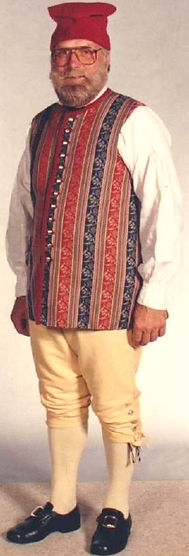

North and West Zealand, 1770
The original vest can be found at the Holbæk Museum. Some say this vest pattern could be seen throughout Denmark (Anna-Margrethe Johnsson). There is a vest almost exactly like this one on the Røsnæs page.
Image credit: Folkedragt.dk

North Zealand, 1800
This costume is based upon a vest in private ownership which is brown hvergarn (linen and wool) with a red "rose" pattern (sounds a lot like Hedebo's "plettøj" pattern to me).
Headgear was reportedly the black hat shown above, or a red knit cap.
Image credit: Licensed from Folkedragt.dk

North Zealand, 1780
Image credit: Folkedragt.dk

In 1979, the predecessor organization to the Danish Folk Costume Society put on an exhibition, displaying the finest example of the Nordsjælland men's costume.
Image credit: Folkedragt.dk

Nordsjælland man, 1840
Image credit: Folkedragt.dk

Helsinge vest fabric closeup
You may occasionally find this fabric for sale at:
http://danskfolkedragtforum.dk/webshop/ws-/--øvrige-metervare
Image credit: Folkedragt.dk
