

Præstø County, Zealand

Præstø County within Denmark

Various Areas within Præstø County, Zealand
Præsto Municipality (red)
Stevns Herred (orange)
Næstved Municipality (blue)

South Zealand, 1835
In the dress fabric above, the small rows of yellow-red flowers are combined with narrow stripes on a dark background. The ideal figure in 1835 was an hourglass figure. The headgear has metal embroidery on the "neck," with long, wide silk ribbons. Over the hat is a fairly large cross-cloth ("korsklæde") of Tønder lace, tied firmly under the neck with ribbons.
Text credit: "KBH" of Danish Folk Costume Society, 1991
Image credit: Licensed from Folkedragt.dk

South Zealand, 1835
Image credit: Licensed from Folkedragt.dk

Præstø County bridesmaid, 1840-1850
from "Folkedragter i Danmark" by Ellen Andersen, 1952
At weddings, unmarried girls wore the same headdress as the bride, only less elaborate. The bride wore a black dress. Bridesmaids wore a red nattrøje (sweater), bodice, green skirt, a white apron and white neck scarf. What makes this a bridesmaid costume is the white apron, white neckscarf and fancy headgear.

Image Credit: Mikael Bjerregaard

A member of Stevns Folkedansere in a terrifically authentic Præstø costume. The bodice fabric is perfect!
Image credit: Bente Bülow

Stevns

Stevns Herred, Præsto County, Østjylland, 1820-1850
from "Folkedragter: Landboliv I Fællesskabets Tid" by Minna Kragelund, 1972
The woman is wearing a costume from Stevns Herred. The red sweater sleeves are knitted wool and the apron is a typical Stevns pattern. Under the silk shoulder scarf lies a white muslin scarf. Bodice and skirt are of "hvergarn" (wool + linen).
The man, who is from the area closer to the town of Præstø, is wearing his sunday finest with a neckerchief and linen shirt (center image), and regular work clothes with knitted wool sleeves (right image). In both male images, the breeches are made of deerskin. The knitted cap is brown with red trim. I know of no other Danish region that features a brown cap.
The text "Folkedragter" by Minna Kragelund, from which this image comes, appears to say that around the beginning of the Empire Period (circa 1800), men's vests started to use plain (aka inexpensive) fabric on the back of the vest.


In 1979, the predecessor organization to the Danish Folk Costume Society put on an exhibition, displaying the finest example of the Stevns costume.
Image credit: Folkedragt.dk

A member of Stevns Folkedansere in a painstakingly authentic Stevns costume. The skirt fabric looks spot on!
Image credit: Bente Bülow
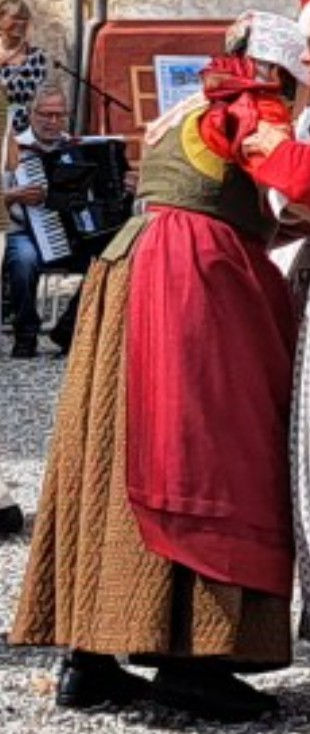
A member of Stevns Folkedansere in another authentic Stevns costume. It has all the Stevns hallmarks: correct skirt fabric, red apron, green bodice, red nattrøje.
Image credit: Stevns Folkedansere

Stevns costume made in 1948
Image credit: National Museum of Denmark


Stevns Peninsula man, 1820-1830
from "Folkedragter i Danmark" by Ellen Andersen, 1952
The short-lived fashion of the Empire Period first penetrated the countryside in the 1820s and 1830s. Both the vest and shirt had a high stand-up collar. The many silver buttons were family heirlooms. The jacket above is a checkered dark blue, and the leather trousers have fine embroidery at the front. An almost-indispensable accessory was the silver-plated meerskum pipe.

Supposedly Præstø

Stevns man, 1800
Image Credit: Licensed from Folkedragt.dk
Næstved

Festive Naestved Headgear, 1830-1860
Headgear like this one was made by professional female hatmakers. Pictured above is a particularly exquisite example.
Præstø headgear appears comparable to Hedebo headgear, but the embroidery technique was reportedly different.

Supposedly, this is the men's vest pattern for Næstved, Præsto County (according to its seller on FaceBook's Danske Folkedansere page). I am unable to independently verify that assertion.
Leestrup
